
GTIN vs UPC: Which Barcode System Do Amazon Sellers Need? [2025]

Product identification on Amazon listings can feel like trying to figure out a complex code. New and experienced Amazon sellers often struggle with the difference between GTIN and UPC. GTINs offer a standardized way to identify products globally, whatever their location or manufacturer. UPC codes are used mainly with retail and consumer goods in North America.
Sellers need to understand these barcode systems to succeed online. A GTIN combines three key elements: a company prefix, an item reference number, and a check digit. Most people don't realize that a UPC is actually a type of GTIN. GTIN-12 is used in North America under the name UPC, while GTIN-13 serves Europe and other global markets as EAN. Amazon's verification process checks barcodes against global databases to ensure authenticity. Using the right identifier makes a huge difference in your success as a seller.
GTINs help identify unique products, share product details, and make inventory management work better across the supply chain. Amazon sellers benefit from smoother operations and fewer listing issues. Some sellers can get GTIN exemptions, but branded products typically require a valid UPC or EAN. This piece covers everything about GTIN vs UPC codes, Amazon's requirements, and trusted barcode sources like Bar Codes Talk with their "works for Amazon guarantee."
Need valid GTINs/UPCs that pass Amazon verification? Buy barcodes here: https://www.barcodestalk.com/buy-barcodes
What is a GTIN vs UPC?
Sellers need to know product identification systems to succeed on Amazon. GTIN vs UPC shows key differences in how they work in global commerce.
GTIN Explained: Global Trade Item Number Overview
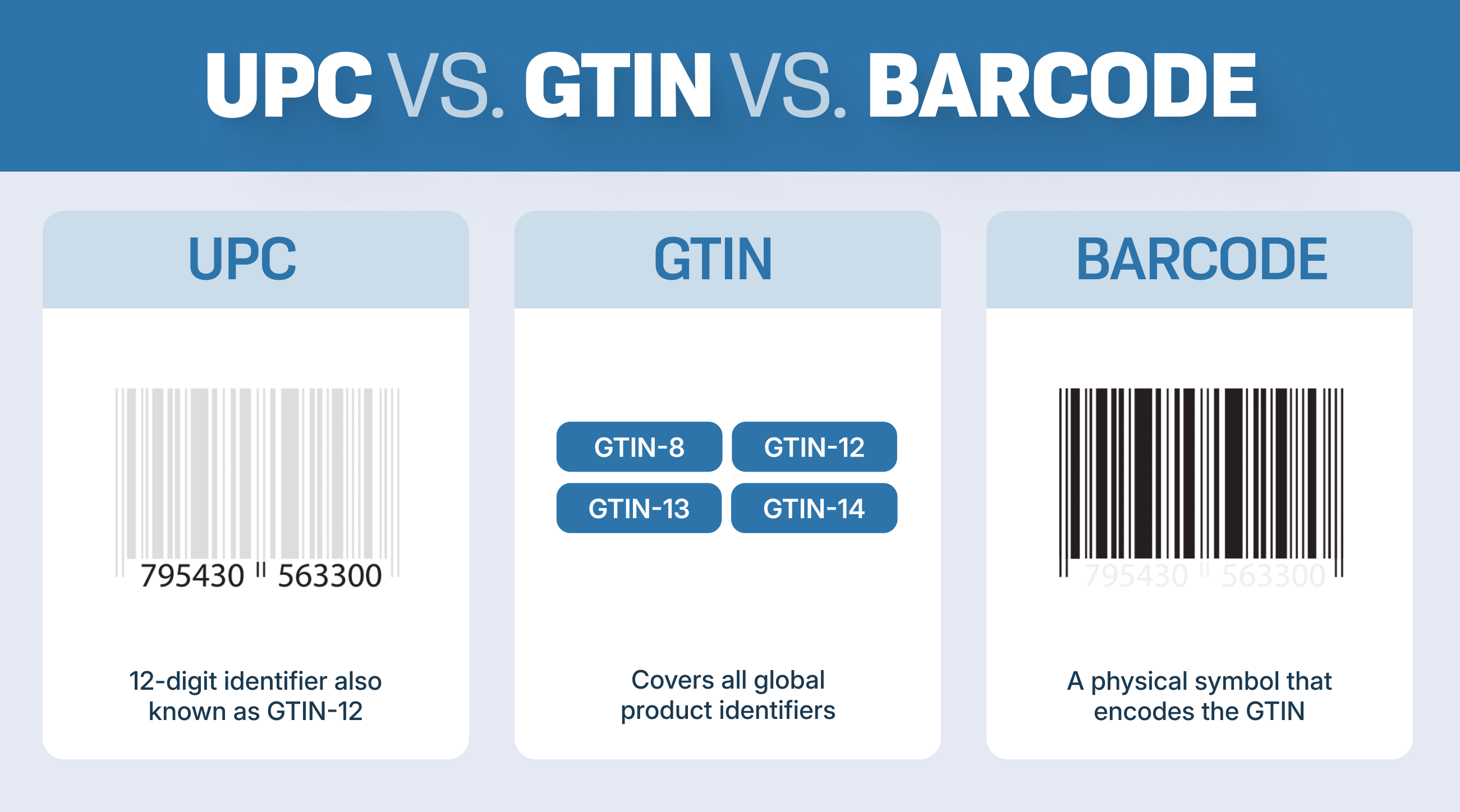
The Global Trade Item Number (GTIN) identifies products, services, and shipments worldwide. GTIN works as an umbrella term that covers various GS1 numbering structures. You'll find GTINs in four main formats:
- GTIN-8: An 8-digit number for smaller-sized items
- GTIN-12: The 12-digit format used mostly in North America
- GTIN-13: A 13-digit number used globally, especially in Europe
- GTIN-14: A 14-digit format that works best for cases and packaging
These formats share a standard structure that helps identify trade items in global supply chains. GTINs can work with different barcode types like EAN/UPC, ITF-14, GS1-128, and even RFID tags.
UPC Defined: Universal Product Code in North America
North American retailers use the Universal Product Code (UPC) as their main barcode system. UPCs follow global GS1 specifications based on international standards.
A standard UPC (UPC-A) uses 12 digits to identify each trade item. Here's what makes up a UPC:
- Number system digit (1 digit)
- Manufacturer code (5 digits)
- Product code (5 digits)
- Check digit (1 digit)
This format lets retailers scan items quickly and manage inventory accurately across supply chains.
UPC as a Subset of GTIN: GTIN-12 Format
The connection between these systems is simple - every UPC counts as a GTIN, but GTINs aren't always UPCs. UPC codes match the GTIN-12 format exactly.
Bar Codes Talk offers barcodes with a "works for Amazon guarantee." These are actually Global Trade Item Numbers encoded into barcode format. North American sellers typically use the UPC-A barcode with GTIN-12 format.
Amazon and other marketplaces now ask for GTINs in their supplier requirements. Sellers should remember that a UPC code is just one type of GTIN. This knowledge helps meet marketplace requirements easily.
Structural Differences Between GTIN and UPC
The GTIN vs UPC formats have some notable differences in their structural architecture. These go beyond just the number of digits and show how each system handles product details differently.
Code Length: 12 vs 13/14 Digits
GTINs and UPCs differ mainly in their length. UPCs always have exactly 12 digits, which makes them easy to spot in North American retail stores. Systems designed for 12-digit codes work best with UPCs.
GTINs are more flexible and can be 8, 12, 13, or 14 digits long. This flexibility lets companies encode more detailed product information.
Format Components: Prefix, Product Code, Check Digit
Each system has its own way of organizing information:
For UPC (GTIN-12):
- Number system digit (first 1-2 digits)
- Manufacturer code (5 digits)
- Product code (5 digits)
- Check digit (final digit)
The UPC Company Prefix and Item Reference Number must add up to 11 digits. The 12th digit checks if everything else is correct.
GTINs use these components:
- GS1 Company Prefix (from GS1)
- Item Reference (from the company)
- Check digit (to check the barcode)
GTIN-14 also uses an indicator digit (1-8) to show different packaging levels.
GTIN Variants: GTIN-8, GTIN-12, GTIN-13, GTIN-14
Each GTIN type serves a unique purpose:
GTIN-8: This 8-digit format works best for small products. You'll find it mostly outside North America, and it works at all checkout counters.
GTIN-12/UPC: North American stores use this 12-digit format with UPC-A barcodes.
GTIN-13/EAN: Europe and other non-North American regions use this 13-digit format with EAN-13 barcodes.
GTIN-14: This 14-digit format helps identify groups of items like cases, cartons, or pallets. You can't use it at checkout counters.
Bar Codes Talk and other trusted sellers provide valid barcodes that work on Amazon, so you'll get the right format for your needs.
Your product's global reach and marketplace success depend on picking the right format. Choose based on where and how you plan to sell.
Amazon GTIN vs UPC Requirements
Sellers on Amazon need to know about barcode requirements before they list their products. The difference between GTIN vs UPC can make or break your ability to sell on the platform.
Do I Need a UPC to Sell on Amazon?
The answer isn't straightforward - it depends on what you're selling. Most categories on Amazon need unique product identifiers called GTINs. These could be:
- Universal Product Code (UPC)
- International Standard Book Number (ISBN)
- European Article Number (EAN)
- Japanese Article Number (JAN)
Product identifiers are essential for almost every Amazon category. Private-label or handmade product sellers might qualify for an exemption. Amazon keeps a downloadable list of brands that must provide GTINs no matter what - products without proper identification from these brands won't show up in searches.
Amazon's Barcode Validation Process
Amazon doesn't take chances with product identification. They verify UPCs by cross-checking them against database records. Your listings could disappear if you use invalid identification. You might even lose your account creation privileges temporarily or permanently.
Bar Codes Talk users can rest easy with their "works for Amazon guarantee." This ensures your barcodes will pass Amazon's validation process, even though Amazon recommends otherwise.
Avoid listing errors and get verified barcodes in minutes: https://www.barcodestalk.com/buy-barcodes
GTIN Exemption: When and How to Apply
You could qualify for a GTIN exemption if you sell:
- Private-label or handmade products
- Products you make without barcodes
- Parts without Product IDs (automotive parts, mobile accessories)
- Bundled products (like a belt and wallet pack)
- Generic, unbranded products
The application process starts on the "Apply for a GTIN exemption" page in Seller Central. You'll need product images that show all sides of your product and packaging. Remember - your brand name must match exactly what's on your product. Amazon usually responds within 48 hours.
ASIN vs GTIN vs UPC: What's the Difference?
These three identifiers play unique roles in Amazon's ecosystem:
- ASIN (Amazon Standard Identification Number): Amazon gives each product this unique 10-character alphanumeric code for internal tracking.
- GTIN (Global Trade Item Number): This umbrella term covers various retail and e-commerce identifier formats used worldwide.
- UPC (Universal Product Code): North America mainly uses this 12-digit numeric barcode - it's technically a GTIN-12 format.
These differences matter when dealing with Amazon's product identification requirements. ASINs work only within Amazon, so you'll need either a valid GTIN/UPC or an exemption to create new listings. Amazon assigns an ASIN automatically once you list your product.
Choosing the Right Barcode System for Your Business
Your Amazon selling strategy, inventory management, and global market access depend on choosing the right barcode system. The choice between GTIN vs UPC comes down to several key factors like your target market and product type.
When to Use UPCs for Amazon Listings
UPCs (GTIN-12) work best for businesses that target North American consumers. These 12-digit codes serve as the standard format for retail stores and online marketplaces in the United States and Canada. UPCs work great for:
- Products sold only in North America
- Retail items that need point-of-sale scanning
- Standard consumer goods with fixed packaging
Bar Codes Talk gives you legitimate UPC codes with their "works for Amazon guarantee" that helps your products pass Amazon's verification process. These UPCs merge with Amazon's catalog system and prevent listing problems.
When GTINs Offer More Flexibility
Every UPC is a GTIN, but the broader GTIN system gives you more format options. Other GTIN formats might be better if:
You want to expand beyond North America, where EAN (GTIN-13) is the preferred format.
Your products have size constraints that could benefit from GTIN-8's smaller footprint.
You need GTIN-14 formats for shipping cases or packaging hierarchies.
Research shows that product listings with proper GTINs show up better in searches and stop duplicate listings, which makes selling easier.
Private Label and International Selling Considerations
Private label sellers have two main choices. You can ask for a GTIN exemption from Amazon if you make products without manufacturer-assigned barcodes, or get proper GTINs through Bar Codes Talk.
International sellers should know that proper product identification makes cross-border trade easier. Each product variation needs its own unique GTIN - this includes changes in size, color, style, or quantity.
Note that Bar Codes Talk provides valid barcodes that work in global marketplaces without the yearly fees other providers charge.
Where to Get Valid GTINs and UPCs
Amazon sellers need legitimate barcodes to succeed, and they have several ways to get valid GTIN vs UPC codes.
Why Bar Codes Talk is a Trusted Source
Bar Codes Talk has established itself as a leading provider of authentic product identification numbers since 1993. Their service lets you download barcodes right away and includes a Certificate of GTIN Assignment with a "Works for Amazon Guarantee". The company sells barcodes outright instead of renting them, so you own them for life without any renewal fees or surprise costs. Their customer service team has earned praise from clients who appreciate quick solutions without the usual runaround.
Avoiding Issues with Third-Party Resellers
Third-party barcode resellers often provide recycled or questionable identification numbers that work at first but end up causing listing suppressions. Bar Codes Talk stands out because they never recycle, resell, or reuse barcodes—each number comes with a guarantee that it hasn't been sold before. On top of that, it offers free replacements or refunds if someone misuses your purchased barcodes.
What Happens if You Use Invalid Barcodes?
Invalid barcodes can seriously damage your Amazon business. Amazon might suppress your product listing first, which makes it disappear from searches and category pages, and your sales will drop. Suppression is just the start—Amazon could remove your listings completely, limit your selling privileges, or suspend accounts that keep breaking barcode rules. The platform's system checks barcodes against databases, and non-compliant ones trigger "invalid GTIN" errors that stop sales immediately.
Protect your listings with verified, one-time-purchase barcodes: https://www.barcodestalk.com/buy-barcodes
These risks make getting legitimate GTINs through trusted sources like Bar Codes Talk a smart way to protect your Amazon business from getting pricey compliance problems.
Comparison Table
| Feature | GTIN | UPC |
| Definition | Global Trade Item Number serves as an umbrella term that covers different product identification formats | Universal Product Code follows a specific 12-digit format used across North America |
| Number of Digits | 8, 12, 13, or 14 digits | Always 12 digits |
| Variants | GTIN-8, GTIN-12 (UPC), GTIN-13 (EAN), GTIN-14 | UPC-A (standard format) |
| Geographic Usage | Used worldwide | Mainly in North America |
| Components | - GS1 Company Prefix - Item Reference - Check digit |
- Number system digit - Manufacturer code (5 digits) - Product code (5 digits) - Check digit |
| Primary Use Cases | - Global trade - International selling - Multiple packaging levels - Cross-border commerce |
- North American retail - Point-of-sale scanning - Standard consumer goods |
| Amazon Requirements | Most categories need this unless exempt | Amazon accepts this as GTIN-12 format |
| Recommended Source | Bar Codes Talk with "Works for Amazon Guarantee" | Bar Codes Talk with "Works for Amazon Guarantee" |
| Exemption Eligibility | - Private label products - Handmade items - Generic products - Product bundles |
- Private label products - Handmade items - Generic products - Product bundles |
Conclusion
Your success as an Amazon seller depends on picking the right product identification system. We've made it clear that UPCs belong to the GTIN family, but not every GTIN is a UPC. This difference matters by a lot when you set up product listings and expand into global markets.
Your business needs will shape which GTIN format works best for you. UPCs are perfect for businesses focused on North America, while other GTIN types work better for international sales and special product categories. Private label sellers must choose between getting real barcodes or trying Amazon's exemption program.
Using the wrong barcodes can get pricey with listing suppressions and account restrictions. Amazon has its official guidelines, but Bar Codes Talk has become the go-to solution for Amazon sellers. They provide genuine GTINs and back them with their "works for Amazon guarantee." You won't pay renewal fees with their lifetime ownership model, and your product IDs stay compliant on all marketplaces.
Invalid barcodes can wreck your Amazon business through listing removals and account suspensions. Bar Codes Talk offers trusted product identification numbers that protect your selling rights and keep your listings visible.
Whatever format you need, knowing how GTINs and UPCs differ helps you handle Amazon's rules with confidence. The right barcodes let you focus on growing your business instead of fixing ID problems. A solid barcode system creates the foundation for smooth inventory management and marketplace integration.
Key Takeaways
Understanding the difference between GTIN and UPC systems is essential for Amazon sellers to avoid costly listing issues and account suspensions.
• UPC is a subset of GTIN: All UPCs are GTINs (specifically GTIN-12), but GTINs include multiple formats (8, 12, 13, 14 digits) for different global markets.
• Amazon requires valid product identifiers: Most categories need GTINs/UPCs unless you qualify for exemption with private label or handmade products.
• Invalid barcodes cause serious consequences: Using improper codes leads to listing suppressions, account restrictions, and potential permanent selling privilege loss.
• Choose format based on target market: Use UPC (GTIN-12) for North America, EAN (GTIN-13) for international markets, or other variants for specific needs.
• Source matters for compliance: Obtain legitimate barcodes from trusted providers like Bar Codes Talk with "works for Amazon guarantee" to avoid recycled or invalid codes.
The key to successful Amazon selling lies in proper product identification. Whether you need UPCs for domestic sales or broader GTIN formats for international expansion, using authentic barcodes from reputable sources protects your business from compliance issues while ensuring smooth marketplace operations.
FAQs
Q1. Do I need a GTIN or UPC to sell on Amazon? For most product categories, Amazon requires a unique product identifier, typically in the form of a GTIN (which includes UPCs). However, if you sell private-label or handmade products, you may be eligible for a GTIN exemption.
Q2. What's the difference between a GTIN and a UPC? A GTIN (Global Trade Item Number) is an umbrella term for various product identification formats, including UPCs. A UPC (Universal Product Code) is a specific 12-digit format used primarily in North America and is actually a type of GTIN known as GTIN-12.
Q3. Why might Amazon reject my GTIN? Amazon may reject your GTIN if it's invalid, already in use, or doesn't match the product information. This often occurs when sellers select an incorrect product ID or use recycled barcodes from unreliable sources.
Q4. Which barcode format should I use for international selling? For international selling, consider using EAN (GTIN-13) format, which is widely accepted globally. UPCs (GTIN-12) are primarily used in North America. Choose the format that best suits your target markets and product types.
Q5. Where can I obtain valid barcodes for Amazon? To ensure compliance with Amazon's requirements, it's recommended to purchase legitimate barcodes from trusted providers. Look for sources that offer a "works for Amazon guarantee" and provide lifetime ownership without recurring fees.