
GS1 vs Third-Party Barcodes: Which Option Saves Amazon Sellers Money in 2026?
GS1 Barcodes vs Third-Party Barcodes: The Real Cost Difference
The price difference between official GS1 and third-party barcode options can be staggering. A single code through GS1 US costs $30, yet the same GS1-origin UPC might cost just a few dollars—or even cents—from a legitimate third-party provider. This substantial gap leaves many Amazon sellers questioning which option saves money without future complications when it comes to Amazon product barcodes.
Bar Codes Talk stands as the leading source for GTIN, EAN, and UPC barcodes, with more than 200,000,000 barcodes sold through major brick-and-mortar stores and online retailers. You don't always need to buy directly from GS1 to get functional, accessible barcodes for Amazon products, despite what some marketplaces might suggest.
Amazon supplier stories can raise concerns. One seller's products, generating over $100,000 in monthly sales, were affected by barcode issues. However, reliable third-party options exist. GS1's recent addition of a single GTIN purchase option without renewal fees shows their adaptation to third-party competition.
Your bottom line in 2026 could be substantially affected by the cost differences between GS1 and third-party barcodes, whether you're launching your first product or managing an existing catalog. This piece breaks down the essential information you need before making this vital business decision about buying UPC codes.
If you want to avoid ongoing GS1 renewal fees and still meet Amazon’s barcode requirements, you can buy verified UPC, EAN, and GTIN barcodes directly from Bar Codes Talk with lifetime ownership and an Amazon compatibility guarantee.
Understanding GS1 Barcodes and Third-Party Barcodes for Amazon Sellers
Barcodes show data that machines can read through patterns of bars and spaces with different widths. Companies use them for product identification and to track inventory as items move through supply chains.
GS1 barcodes work worldwide as standard identifiers that contain Global Trade Item Numbers (GTINs) - unique numbers for specific products. Each barcode has a GS1 company prefix that connects to a specific brand. The prefix comes with an item number and a check digit that stops wrong scans.
Companies looking for other options can get valid GS1-origin barcodes from providers like Bar Codes Talk. These barcode resellers get their codes from companies that bought large prefixes but never used them or closed down. Bar Codes Talk leads the market in GTIN, EAN, and UPC barcodes and guarantees they work with Amazon.
Online marketplaces check product legitimacy by scanning the identification number in their data hub. Some retailers might need specific barcode types based on your selling platform.
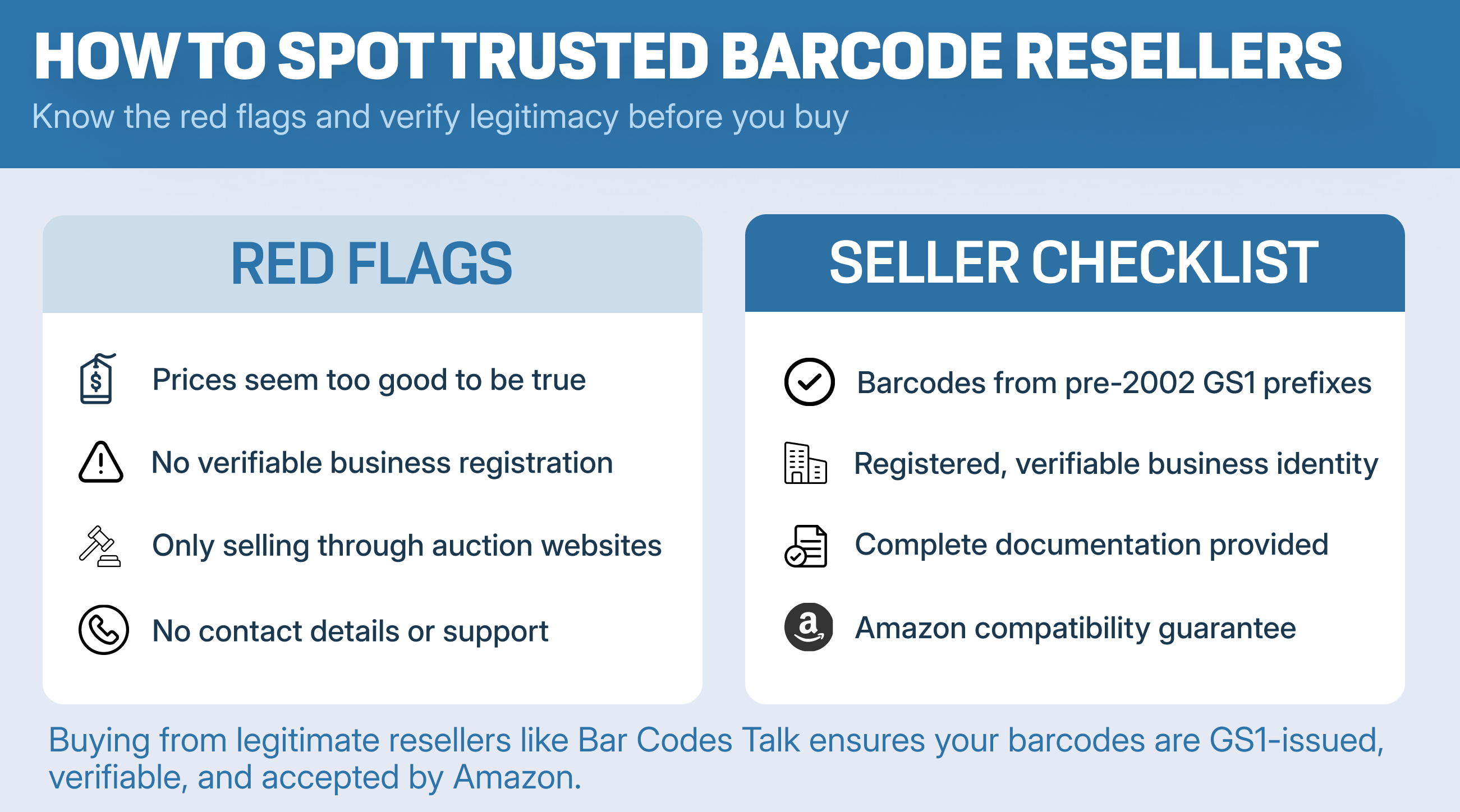
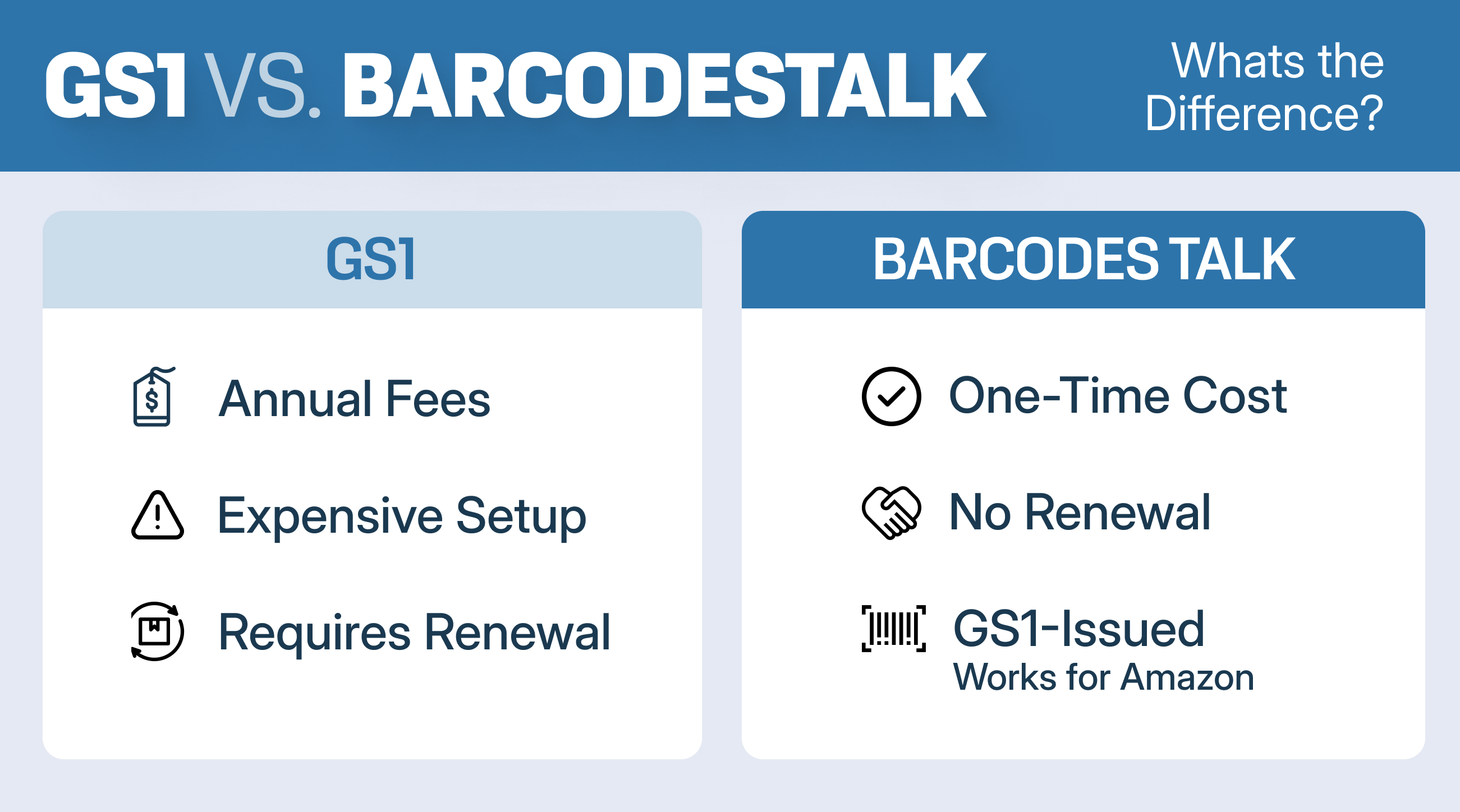
The main difference in buying options comes down to ownership structure, not how they work. Third-party resellers give you permanent ownership without yearly fees. Traditional registration costs money every year.
GS1 and third-party barcodes work the same way in scanning systems. The barcode images look exactly alike - we just register them differently and pay different costs.
Cost and Ownership Differences of GS1 UPC Barcodes
The most striking difference between barcode options lies in their pricing structure. GS1 uses a subscription model where you lease barcodes through annual fees rather than owning them outright.
The numbers tell an interesting story. GS1 US charges $250 for just 10 barcodes plus $50 in annual renewal fees. Costs climb sharply as your needs grow - you'll pay $750 initially plus $150 yearly for 100 barcodes. A package of 1,000 barcodes costs $2,500 upfront with $500 annual fees.
Bar Codes Talk takes a different approach with lifetime ownership through one-time payments. Their current pricing starts at $5 for a single barcode, $15 for 10 barcodes, $45 for 100 barcodes, and $180 for 1,000 barcodes. These barcodes belong to you forever with no renewal needed.
These price differences add up quickly over time. A business needing 100 barcodes would pay GS1 $750 plus $150 yearly, reaching $1,350 after four years. The same business would pay just $45 once with Bar Codes Talk, offering significant savings for high-volume sellers.
GS1 launched a $30 single-GTIN option without renewal fees recently, though this costs more than what third-party vendors charge for Amazon UPC codes.
The ownership model makes another key difference - GS1 only licenses their prefixes instead of selling them. Bar Codes Talk provides barcodes from legally acquired pre-2002 prefixes, giving you permanent, transferable ownership rights without ongoing fees.
Retailer Acceptance and Amazon Barcode Requirements for GS1 UPC Codes
Barcode policies differ in a variety of retail platforms and marketplaces. You need to understand these requirements to make smart decisions about barcode sourcing, especially when it comes to Amazon barcode requirements.
Online sellers must ensure their platform stays compatible. Shopify has dedicated barcode fields in product listings that enable inventory tracking, POS system synchronization, and integration with Google product listings, Amazon, and Facebook. WooCommerce sellers can use barcodes to their advantage with inventory plugins, marketplace syncing, and warehouse management.
Most large retailers check barcodes against ownership databases, though some exceptions exist. Research shows that several major brick-and-mortar stores demand direct-source codes. These include:
- Walmart/Sam's Club
- Kroger/Fred Meyers
- Macy's/Bloomingdale's
- Home Depot
- Costco
Amazon's barcode requirements depend on your specific situation. While Amazon claims to verify "authenticity of product UPCs by checking the GS1 database", Bar Codes Talk offers a "Works for Amazon Guarantee" that protects your listing ability. Their barcodes work well in Amazon's system unless you've enrolled in Amazon's Brand Registry program.
Bar Codes Talk's valid barcodes can future-proof your product catalog, even if you only sell through your own store now. This makes expansion to other marketplaces easier later. Their Certificate of Authenticity confirms your legal ownership of the numbers, allowing them to work in virtually every POS system worldwide.
GS1 UPC Barcodes vs Third-Party Barcodes: Cost Comparison Table
| Comparison Criteria | Bar Codes Talk | Traditional Subscription Model |
| Single Barcode Cost | $5 | $30 |
| 10 Barcodes Cost | $15 | $250 + $50 annual fee |
| 100 Barcodes Cost | $45 | $750 + $150 annual fee |
| 1,000 Barcodes Cost | $180 | $2,500 + $500 annual fee |
| Ownership Model | Permanent ownership without renewal fees | Annual subscription that needs renewal |
| Transferability | Complete ownership rights you can transfer | Licensed usage rights only |
| Amazon Compatibility | Amazon guarantee included | Works with Amazon except with Brand Registry |
| General Retail Compatibility | Works with all major POS systems worldwide | Compatible with leading retailers |
| Legal Status | Legally obtained pre-2002 prefixes | Standard registration |
| Certificate Provided | Ownership Certificate included | Not specified |
| 4-Year Cost (100 Barcodes) | $45 one-time payment | $1,350 (base cost + renewals) |
Conclusion
Looking at the clear differences between barcode options shows how third-party barcodes make financial sense for Amazon FBA sellers and other e-commerce businesses. Bar Codes Talk lets you own barcodes forever at a much lower cost than subscription-based options. You'll save big money - paying $45 once for 100 barcodes instead of $1,350 over four years with other options.
The savings go beyond just the upfront costs. A one-time payment removes any budget guesswork and protects you from unexpected renewal fees that could affect your planning. Growing businesses with changing cash flow find this predictability especially valuable for inventory management.
Ownership rights make a huge difference too. Bar Codes Talk gives you full ownership rights you can transfer freely, while subscriptions only let you use the codes temporarily. Your business should own its tools rather than lease them forever.
Sellers often worry about compatibility, but third-party barcodes work well with almost every point-of-sale system worldwide. Bar Codes Talk guarantees their barcodes for Amazon, which addresses a common concern for marketplace sellers. These codes will serve you perfectly unless you're part of Amazon's Brand Registry program.
The numbers tell the story when you compare long-term costs. Choosing Bar Codes Talk's third-party barcodes saves you thousands while giving you the same basic features for product identification. Your Certificate of Authenticity proves your legal standing, so you can expand to new retail channels whenever you're ready.
For sellers who want to cut barcode costs without risking listing suppressions, Bar Codes Talk offers a simple way to buy UPC and GTIN barcodes once and use them for life—without subscriptions or hidden fees.
Smart business choices need both short and long-term thinking. Bar Codes Talk's third-party barcodes give you better value through permanent ownership, lower costs, and retail compatibility everywhere. Your products need proper identification without breaking the bank - that's why third-party barcodes are the smart choice for budget-conscious sellers in 2026.
Key Takeaways
Understanding the true cost difference between GS1 and third-party barcodes can save your business thousands of dollars while maintaining full functionality across retail platforms.
• Massive cost savings: Third-party barcodes cost $45 for 100 codes versus $1,350 over four years with GS1's subscription model
• Permanent ownership advantage: Bar Codes Talk provides one-time purchase with transferable ownership rights, eliminating annual renewal fees forever
• Wide platform compatibility: Third-party barcodes work on Amazon (with guarantee), Shopify, and virtually all POS systems worldwide
• Major retailer limitations: Walmart, Home Depot, Macy's, and Costco specifically require direct GS1 codes for acceptance
• Smart business planning: Choose based on your sales channels - third-party for online/small retail, GS1 for major brick-and-mortar expansion
For most online sellers and small businesses, third-party barcodes deliver identical functionality at a fraction of the cost, making them the financially smart choice in 2026.
FAQs
Q1. What's the main difference between GS1 and third-party barcodes? GS1 barcodes are globally standardized identifiers issued directly by GS1, while third-party barcodes are sourced from pre-existing GS1 prefixes. The primary distinctions lie in cost structure, ownership rights, and acceptance by certain retailers.
Q2. How much can I save by choosing third-party barcodes over GS1? The cost savings can be substantial. For example, 100 barcodes from a third-party provider like Bar Codes Talk costs $45 as a one-time fee, compared to $1,350 over four years with GS1's subscription model, potentially saving you over $1,200.
Q3. Are third-party barcodes accepted by major online marketplaces? Most online marketplaces, including Amazon, accept third-party barcodes. Bar Codes Talk even offers a "Works for Amazon Guarantee." However, some specific programs like Amazon's Brand Registry may require direct GS1 codes.
Q4. Which retailers require GS1-direct barcodes? Several major retailers specifically require direct-source GS1 codes, including Walmart, Kroger, Macy's, Home Depot, and Costco. If you plan to sell through these channels, you may need to invest in GS1 barcodes.
Q5. What are the long-term implications of choosing third-party barcodes? Third-party barcodes offer significant cost savings and permanent ownership without renewal fees. However, they may limit expansion to certain large retailers in the future. Consider your long-term business plans when deciding between GS1 and third-party options for your private label products or wholesale distribution needs.
About the Author
Brandon Gordon is the CEO and Founder of Bar Codes Talk, a trusted industry leader providing GS1-issued barcodes to more than 200,000 businesses worldwide.
Since founding the company in 2009, Brandon has helped eCommerce sellers and manufacturers navigate barcode compliance with honesty, transparency, and efficiency.
Under his leadership, Bar Codes Talk has become one of the most reliable sources for legitimate GS1 barcodes—helping Amazon sellers avoid costly mistakes and get their products listed quickly.